FIFA World Cup 1962: The Most Unsettling World Cup in Football History
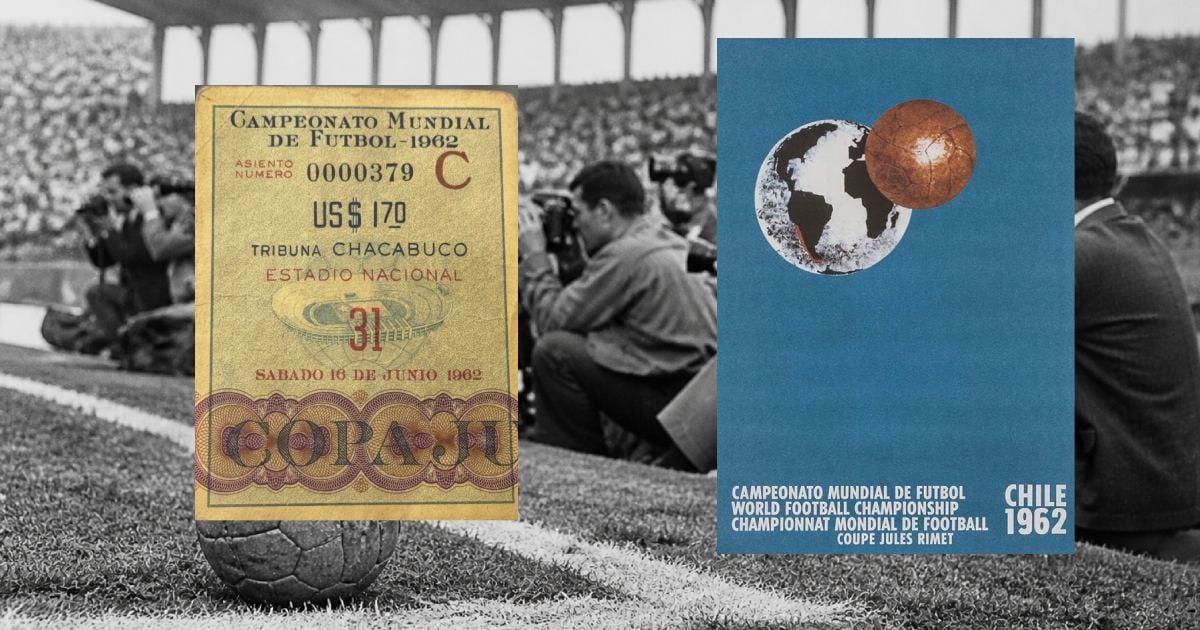
The 1962 World Cup in Chile is rarely found among the most flamboyant tournaments in history. It lacks the romance of Sweden 1958 and the birth of Pelé, as well as the high drama of England 1966 with its eternal goal-line controversies. Yet this World Cup remains one of the most revealing in history. It was the moment football first appeared gritty, uncomfortable, and truly "grown-up".
While Chile might lag behind in terms of media glamour, it was far from a "filler" tournament.
1. A tournament built on catastrophe
The 1962 World Cup almost didn't happen in Chile. Two years before kick-off, the country was devastated by the Valdivia earthquake—the most powerful ever recorded. The destruction was so catastrophic that FIFA seriously considered moving the event.
The tournament was saved by the sheer resolve of Carlos Dittborn, head of the organising committee, who convinced FIFA not to seek a "Plan B." His defiant plea became the symbol of the tournament: "Because we have nothing, we will do everything." It was a bold claim, and while they succeeded, the infrastructure was basic. Teams lived in modest conditions that would be unrecognisable to today’s stars. Furthermore, Chile’s geography—the vast distance from north to south, logistical hurdles, and the contrasting climate from the arid Arica to the cooler central regions—added a layer of extreme physical demand.
2. The 'Battle of Santiago'
Every World Cup has a match that is often described as a “war”, but Chile 1962 produced the definitive one: the group stage clash between Chile and Italy.
The friction ignited long before the opening whistle. Italian journalists Antonio Ghirelli and Corrado Pizzinelli published a series of articles describing Santiago as a "backward hole." The Chilean press retaliated by accusing the Europeans of fascism and mafia ties.
The first foul occurred after just 12 seconds. English referee Ken Aston lost control so completely that police had to intervene on three separate occasions to restore order. Italy’s Mario David was sent off, and his teammate Giorgio Ferrini had to be escorted from the pitch by police after refusing to leave. Chile eventually won 2-0, dumping the two-time champions out of the tournament.
The carnage was so infamous that it prompted Ken Aston to later advocate for the introduction of yellow and red cards, though they wouldn't make their World Cup debut until 1970.
This stray dog invaded the pitch during a 1962 #WorldCup quarter-final 🐕🏆
— FIFA World Cup (@FIFAWorldCup) April 11, 2019
It peed on 🏴@England legend Jimmy Greaves 😲
And was then adopted by 🇧🇷@CBF_Futebol icon Garrincha 🤗#NationalPetDay #TBT
ℹ️👉 https://t.co/F7buZH70Wf pic.twitter.com/6hjw9YefRZ
3. Garrincha and the mascot of Viña del Mar
The quarter-final between Brazil and England (3-1) is remembered for Garrincha’s masterclass and one of the funniest pitch invasions in history. A stray dog wandered onto the field, evading several players for several minutes.
The deadlock was broken by England striker Jimmy Greaves, who got down on all fours to lure the animal over. "The referee had stopped the game, and nobody could get near this dog," Greaves later recalled. "I went down on my hands and knees and whistled. He came over, and as I picked him up to a round of applause, he peed all over my shirt!"
The dog was later flown to Brazil by the publication *O Cruzeiro* and raffled off among the Brazilian squad. Fittingly, it was won by Garrincha, whose brace in that match sent the eventual champions into the semi-finals.
4. The technical failure of 'The Crack'
The official match ball of Chile 1962 was a technical disaster. Known as "The Crack," it featured an innovative 18-panel design meant to improve aerodynamics. However, the manufacturing quality was appalling.
By half-time, the paint would rub off completely, and the seams frequently gave way, causing the ball to lose its spherical shape and become misshapen. During the opening match, referee Ken Aston was so unimpressed that he ordered the Chilean-made balls to be replaced with the European "Top Star" model used four years earlier in Sweden.
From our collection: One of the original CRACK match balls used in the 1962 @FIFAWorldCup in Chile. #football #history pic.twitter.com/58p1Q1GWWR
— FIFA Museum (@FIFAMuseum) March 16, 2017
5. A parade of goalkeeping blunders
Finally, 1962 is remembered for a series of inexplicable goalkeeping errors. The legendary Lev Yashin suffered the most. While matches were not widely televised in the USSR, the criticism was fierce. In a group game against Colombia, the Soviets led 4-1 only to draw 4-4, with Yashin conceding an infamous goal directly from a corner—the first "Olympic goal" in World Cup history.
In the quarter-final against Chile, historians note that Yashin was knocked down twice early in the game but played on, eventually conceding long-range efforts to Leonel Sánchez and Eladio Rojas that he likely would have saved at full fitness.
A similar fate befell Czechoslovakia’s Viliam Schrojf. Despite being named the best goalkeeper of the tournament, he made two costly errors in the final that cost his team the trophy. The Czech delegation claimed he was blinded by the low winter sun and camera flashes, but it appeared to be a case of psychological fatigue at the crucial moment.
Brazil claimed their second consecutive title, with Garrincha assuming the mantle in the absence of the injured Pelé. For the stat-hunters among you, visit our dedicated 1962 FIFA World Cup archive to trace Brazil’s path through Chile. Next stop: 1966, where football finally comes home.

